At a glance: the six, and who they suit
The prices below are those in effect on . They are set by the manufacturer and may change without notice: the model page at the dealership has the current figure.
| Model | Powertrain | Seats | Electric range | Fuel consumption in gas mode | Starting at |
|---|---|---|---|---|---|
| 2026 Kia Carnival HEVFR | Hybrid | 7 or 8 | none for continuous driving | 7.2 L/100 km | $51,397 (as of ) |
| 2026 Hyundai Palisade hybridFR | Hybrid | 7 or 8 | none for continuous driving | 8.1 L/100 km | see current price |
| 2026 Mitsubishi Outlander PHEVFR | Plug-in hybrid | 7 (5+2) | 72 km | 8.6 L/100 km | $53,043 (as of ) |
| 2026 Nissan Rogue plug-in hybridFR | Plug-in hybrid | 7 | 61 km | 9.1 L/100 km | see current price |
| 2026 Volvo XC90 T8FR | Plug-in hybrid | up to 7 | 53 km | 8.9 L/100 km | see current price |
| 2026 Mazda CX-90 PHEVFR | Plug-in hybrid | 7 or 8 | 43 km | 9.2 L/100 km | see current price |
See all the new vehicles in our network
Hybrid or plug-in hybrid: the difference that changes the bill
A hybrid does not plug in. Its small battery recharges while driving and braking, and the electric motor assists the gas engine mainly in the city. The gain does not depend on any habit: the Kia Carnival hybrid is rated at 7.2 L per 100 km, against 11.3 L for the same vehicle with a gas engine, which is 4.1 litres less every 100 kilometres, with no change to your routine.
A plug-in hybrid plugs in, and that is where everything is decided. With a full battery, it runs on electricity for its first 43 to 72 kilometres, depending on the model. With an empty battery, it becomes an ordinary gas vehicle again: between 8.6 and 9.2 L per 100 km for the four here.
Which leads to a conclusion worth stating frankly: a plug-in hybrid that you do not plug in uses more fuel than a regular hybrid. With an outlet at home and a daily drive under 50 kilometres, the plug-in is hard to beat. Without an outlet, the hybrid is the logical choice.
The two hybrids: save without plugging in
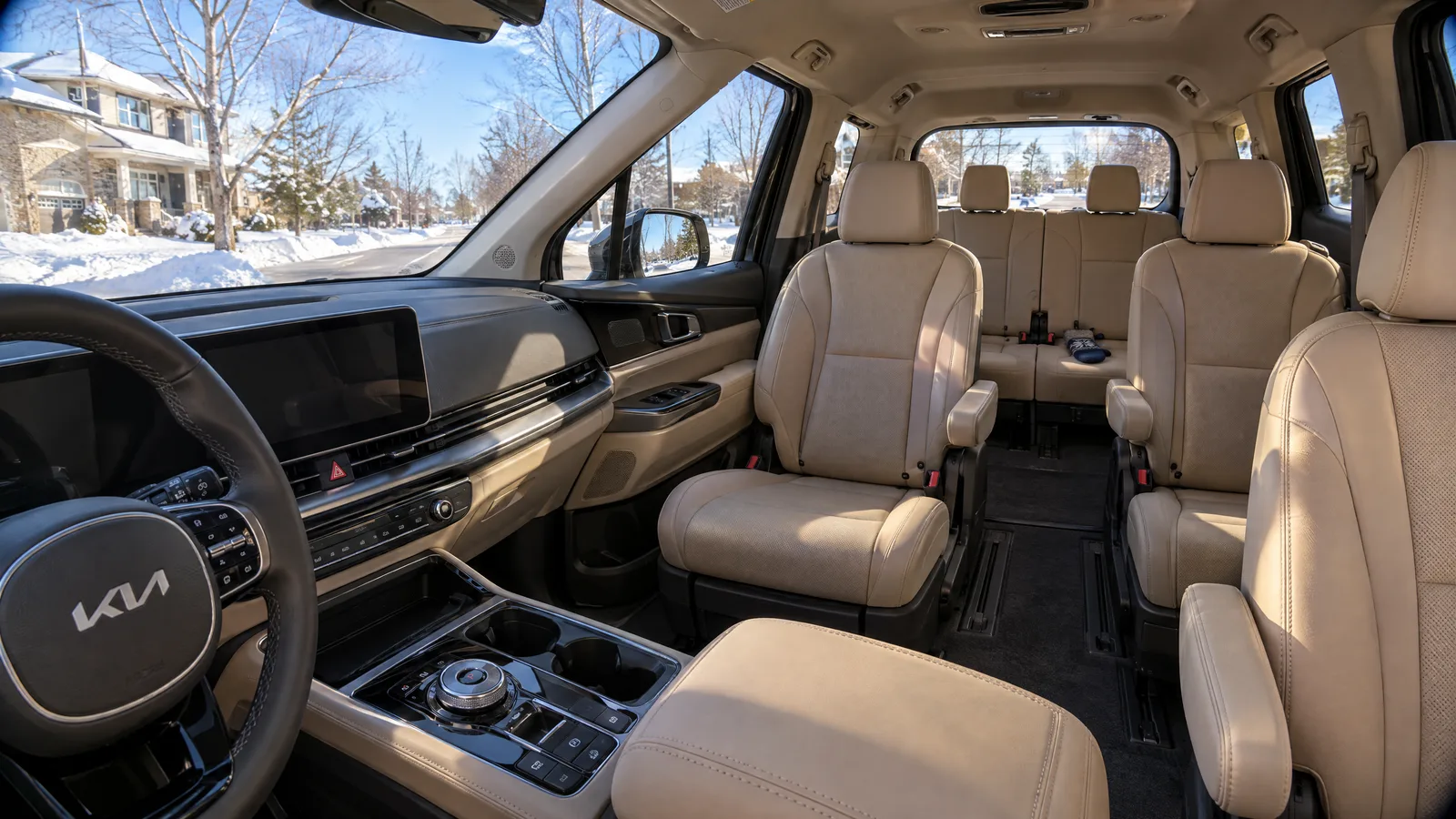
2026 Kia Carnival hybrid — 7.2 L/100 km
It has the lowest official fuel consumption of the six: 6.9 L in the city, 7.5 L on the highway. The pattern is the reverse of a gas vehicle, where the city generally costs more, a sign that the hybrid system works mostly where you stop and start again.
Kia Canada advertises seven or eight seats depending on the second row, a length of 5,155 mm and a towing capacity of 3,000 lb. Sliding doors and a low floor: to get three children and a car seat on board, the minivan is still the most convenient option.
It is sold at the network’s five Kia dealerships, at the same price everywhere, including Kia SherbrookeFR. Starting at $51,397 (as of ), in LX+ trim.
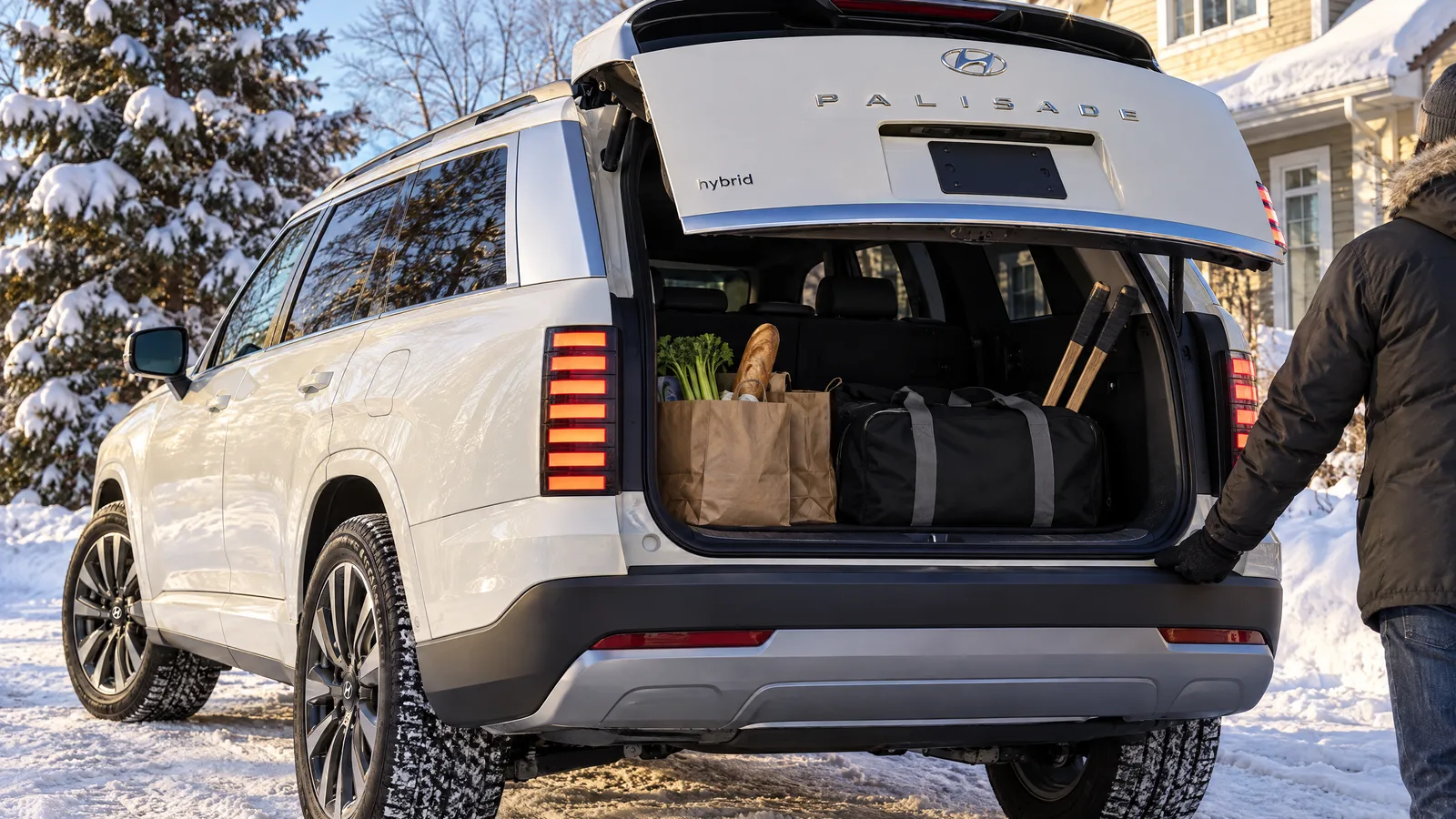
2026 Hyundai Palisade hybrid — 8.1 L/100 km
The Palisade with the 3.5 L six-cylinder engine is rated at 11.9 L per 100 km with all-wheel drive. Its hybrid version, a 2.5 L four-cylinder, drops to 8.1 L: 3.8 litres less every 100 kilometres, in a large seven- or eight-seat SUV that keeps its all-wheel drive.
Hyundai offers both configurations: eight seats with the second-row bench, seven with captain’s chairs and the centre aisle that comes with them. For a family that installs a car seat in the second row, that aisle is often worth the seat it takes away.
It is sold at Hyundai de MagogFR, where you will find the current price of each trim, hybrid included.
The four plug-in hybrids, from longest to shortest electric range
1. 2026 Mitsubishi Outlander PHEV — 72 km on electricity
This is the longest electric range of the six, and for many families in the Eastern Townships and the Montérégie it covers a whole day of trips. With an empty battery, the vehicle uses 8.6 L per 100 km, and Natural Resources Canada gives a charging time of 6.5 hours on a 240-volt charger.
Mitsubishi Canada lists seven seats in a 5+2 configuration and a towing capacity of 680 kg, or 1,500 lb. The third row here is an occasional-use row: two children’s seats, for short trips, in a format that stays compact.
It is sold at Mitsubishi GranbyFR and at Mitsubishi Drummondville, at the same prices. Starting at $53,043 (as of ), in ES S-AWC trim.
2. 2026 Nissan Rogue plug-in hybrid — 61 km on electricity
This is the newcomer, and it moves the Rogue into a different category: where the gas Rogue has two rows, the plug-in version adds a third row and goes up to seven seats. Nissan Canada advertises 61 km of electric range and up to 679 km of combined range; Natural Resources Canada rates it at 9.1 L per 100 km with an empty battery, with a 7.5-hour charge on 240 volts.
It is in the new-vehicle catalogue of the network’s Nissan dealerships, including Nissan SherbrookeFR.
3. 2026 Volvo XC90 T8 — 53 km on electricity
Fifty-three kilometres of electric range, then 8.9 L per 100 km, and a 5-hour charge on 240 volts. Volvo advertises up to seven seats on the XC90, with a third row made up of two separate seats that fold flat.
It is sold at Volvo SherbrookeFR, where you will find the current price of each trim.
4. 2026 Mazda CX-90 PHEV — 43 km on electricity
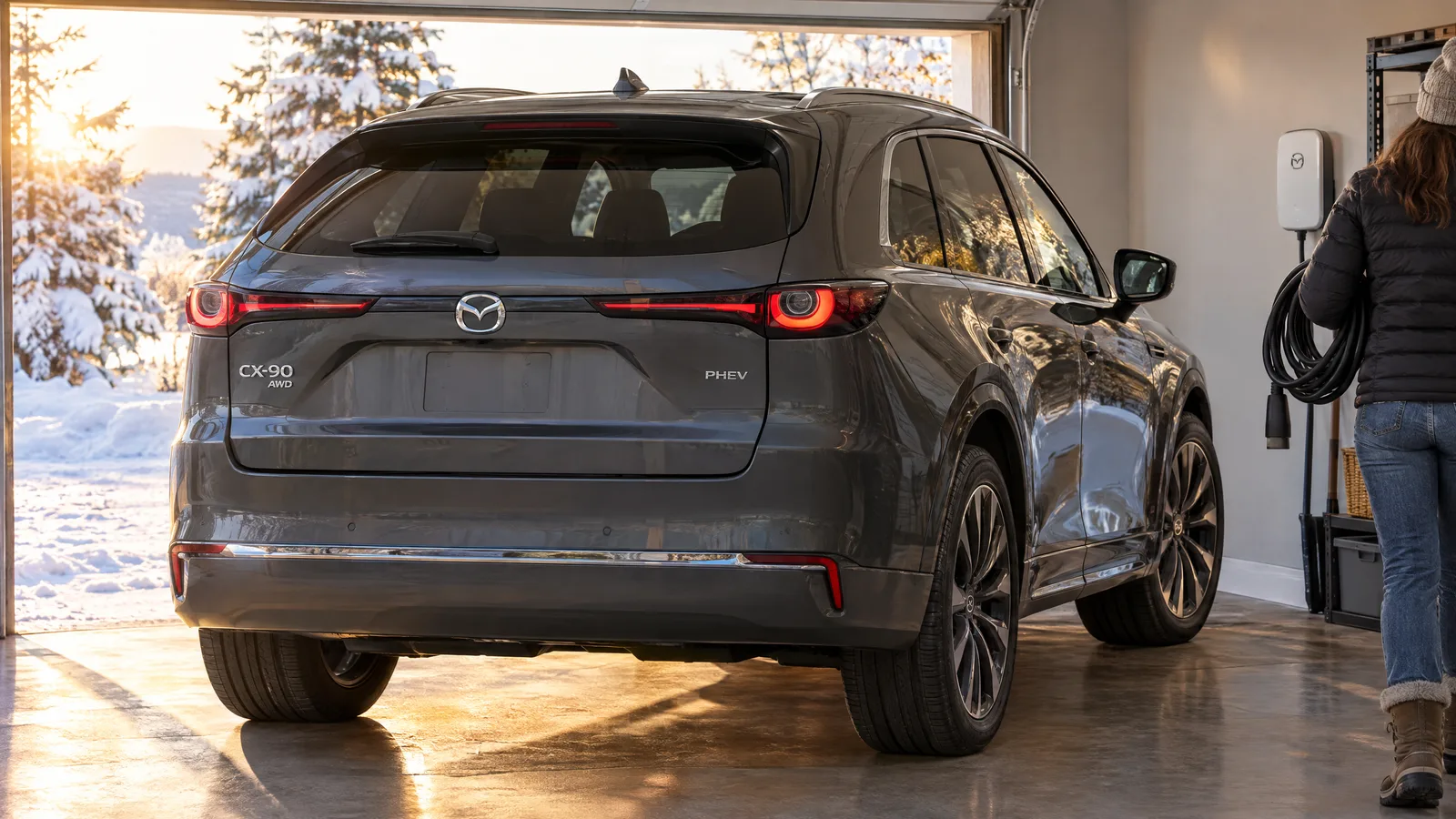
It has the shortest electric range of the group, and the highest fuel consumption once the battery is empty: 9.2 L per 100 km. On the other hand, it is the fastest to charge, 2 hours on 240 volts according to Natural Resources Canada, which lets you top up between two outings on the same day, not only overnight.
Mazda Canada advertises eight seats in a 2/3/3 configuration, standard on the GS and available on the GS-L and GT, or seven seats in a 2/2/3 configuration with captain’s chairs. Towing can reach 3,500 lb.
It is in the new-vehicle catalogue of the network’s four Mazda dealerships, including Mazda Saint-HyacintheFR.
Three traps to know about before you choose
These are the three misunderstandings in this category, and they are discovered after the purchase. Each concerns a specific trim, not an entire model.
- 2026 Kia Sorento hybrid and Sorento plug-in hybrid: six seats. Kia Canada lists six seats with captain’s chairs on both electrified versions. The Sorento does exist with seven seats, but with a gas engine.
- Mercedes-Benz GLE 450e 4MATIC: the GLE offers an optional third row, and Mercedes-Benz Canada states in black and white that it is not available on the plug-in hybrid version.
- Mazda CX-90 mild hybrid: eight seats, but it is not a hybrid in the usual sense: a mild hybrid does not drive on electricity, its battery only assists the engine. Official rating: 9.4 L per 100 km, against 9.2 L for the plug-in version with an empty battery.
The rule to remember: the number of seats is checked trim by trim, not model by model. On several of these vehicles, moving up a trim level takes a seat away instead of adding one.
What the displayed price includes
The amounts in this article are the lowest all-in prices found in the network on . The price shown includes freight and pre-delivery inspection (PDI). Taxes and registration are extra.
No manufacturer rebate is deducted: these rebates change from month to month and live on the offers page, not in an article. Models without a price in the table show it on their dealership’s page.
Compare the network’s plug-in hybrids Get my trade-in appraisal Choose my dealership
 Watch the video on YouTube
Frequently asked questions
Are these prices still current?
They were taken from the network dealerships’ websites on , freight and PDI included; taxes and registration are extra. Manufacturers change them without notice: the model page at the dealership is what counts on the day you buy.
Do you need a charger at home for a plug-in hybrid?
No: a standard 120-volt outlet charges overnight, but it is slow. The times published by Natural Resources Canada, from 2 to 7.5 hours depending on the model, are for a full charge on a 240-volt charger. If your daily drive comes close to the advertised electric range, that charger makes a real difference.
Do these vehicles really use that little fuel in winter?
Less well, like all vehicles. Cold weather reduces the battery’s usable capacity, the heater draws on it, and a plug-in hybrid’s electric range drops noticeably below zero. The gap between two models, however, stays in the same range: that is what makes the comparison useful even when the absolute numbers move.
Does seven seats mean seven adults?
No. On the Outlander PHEV, the third row is an occasional-use row in a 5+2 configuration; on the Carnival and the Palisade, it is much more generous. Trying it with the passengers who will actually sit there remains the only honest way to decide.
What if I want seven seats that are 100% electric?
The network has three: the Hyundai IONIQ 9, the Kia EV9 and the Mercedes-Benz EQS SUV. They are compared on the network’s electric vehicles page.