In brief: the four, and who they are for
| Model | Seats | Cargo, seats up | Combined consumption | Electric range | Who it is for |
|---|---|---|---|---|---|
| CX-30 | 5 | 572 L | 8.7 L/100 km | Does not plug in | Tight parking, tight gas budget |
| 2026 CX-5 | 5 | 954 L | 9.0 L/100 km | Does not plug in | The cargo space of a compact SUV, without the size |
| CX-70 mild hybrid | 5 | 1,131 L | 9.3 L/100 km | Does not plug in | Five seats, but lots of luggage |
| CX-70 plug-in | 5 | 1,130 L | 9.0 L/100 km | 51 km | Short daily commute, home charging station |
| CX-90 mild hybrid | 8 (7 optional) | 423 L behind the third row | 9.4 L/100 km | Does not plug in | Seven or eight people to carry |
| CX-90 plug-in | 8 (7 optional) | 423 L behind the third row | 9.2 L/100 km | 43 km | Large family with a charging station |
See the whole new Mazda lineup in the network
Mild or plug-in hybrid: the real difference
It is the most common confusion with Mazda, and it costs a lot when you get it wrong. Both carry the word “hybrid.” They do not do the same job.
The mild hybrid (MHEV) of the CX-70 and CX-90 is the M Hybrid Boost system: a 48-volt electrical network, a 0.33 kWh lithium-ion battery and a small 16.9 horsepower electric motor. It assists the gas engine at start-up and during acceleration, and recovers energy when braking. It does not plug in, and the vehicle never runs on electricity alone. It is a better-supported gas engine, nothing more.
The plug-in hybrid (PHEV), for its part, carries a 17.8 kWh battery — fifty-four times bigger. It plugs in, and it runs on electricity alone as long as the battery lasts: Natural Resources Canada rates 51 km for the CX-70 PHEV in the GS-SC and GS-L SC trims, 43 km for the GT and Signature trims, and 43 km for the CX-90 PHEV. Once the battery is empty, it becomes an ordinary hybrid and uses between 9.0 and 9.2 L/100 km.
The practical rule: if you do not have a charging station at home or at work, the plug-in loses most of its appeal. If your daily round trip fits under 40 kilometres and you can plug in at night, it is the opposite: most of your weekday trips happen without gas.
A wallet detail rarely seen in brochures: both plug-in models require premium gas, as do the 340 horsepower versions of the mild hybrid CX-70 and CX-90. The 280 horsepower versions, the CX-30 and the CX-5, run on regular.
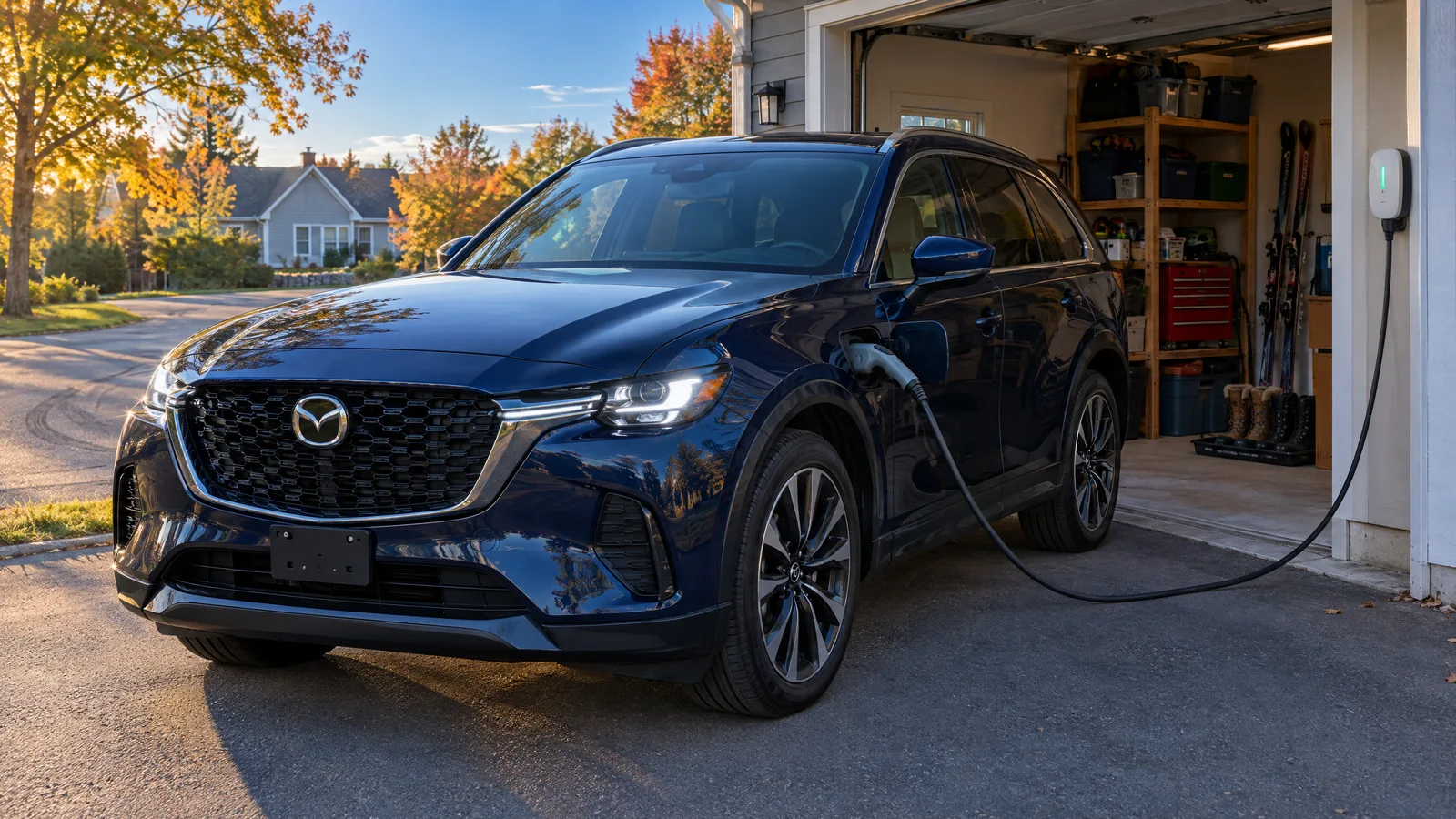
CX-30: the most compact
Five seats, 572 litres behind the rear seats, 1,280 litres once the bench is folded. It is the size that fits in a narrow garage and parks in town without maneuvering.
Two engines, both on regular gas: the 2.5 L Skyactiv-G with 186 horsepower, rated 9.6 L/100 km in the city and 7.5 on the highway, and the 2.5 L turbo with 250 horsepower on 93-octane gas (227 horsepower on regular), rated 10.5 and 7.9. The turbo uses 0.6 L/100 km more in combined driving. No hybrid version in the lineup: the CX-30 is a gas model, period. See the sheet and current price of the CX-30FR.
CX-5: the useful volume without the size
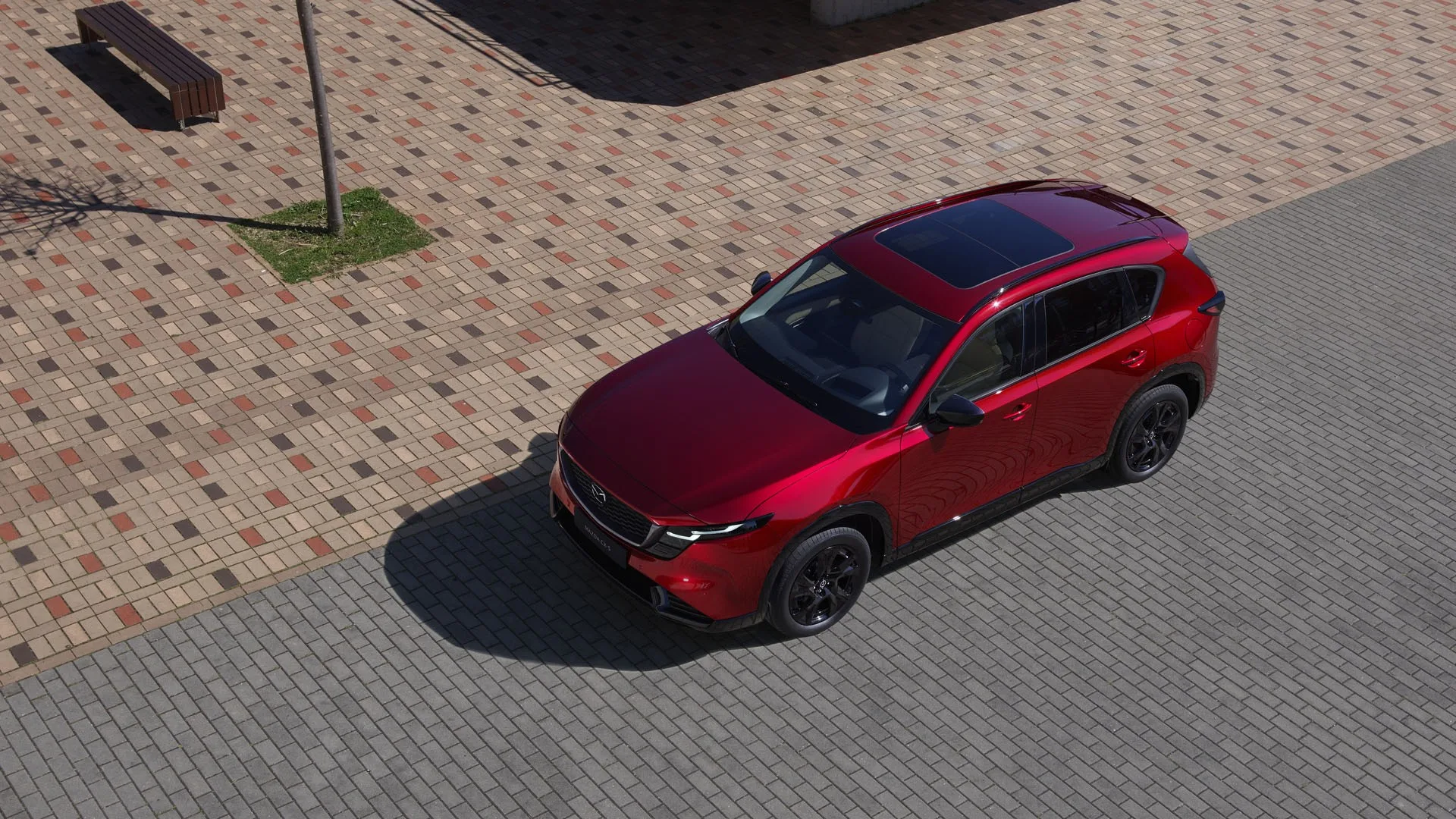
The 2026 CX-5 is entirely new — third generation. It grows by about 11 centimetres compared with the outgoing model, almost all of it in the wheelbase, and the cargo area benefits directly: 954 litres behind the bench, 1,882 litres with the seats folded. That is 382 litres more than the CX-30 with the seats up, for a vehicle that remains a compact SUV.
A single engine: the 2.5 L Skyactiv-G with 187 horsepower and 186 lb-ft, regular gas, six-speed automatic transmission. Official consumption: 9.9 L/100 km in the city, 7.9 on the highway, 9.0 combined. Towing capacity of 680 kg (1,500 lb).
For a family of four that does not tow long trailers and wants an honest cargo area, it is the balance point of the lineup. See the sheet and current price of the 2026 CX-5FR.

CX-70: five seats, large format
The CX-70 often surprises: it shares the CX-90’s body, but it has only two rows and five seats. It is not a scaled-down version, it is a deliberate choice — all the space that would have gone to a third row becomes cargo room.
The result shows in the numbers: 1,131 litres behind the second row with the sunroof, 1,122 litres with the panoramic roof, and 2,147 litres once the rear seats are folded. That is more than double the CX-5 with the seats up.
As a mild hybrid, the 3.3-litre turbo inline-six delivers 280 horsepower on regular gas (9.9 city / 8.4 highway / 9.3 combined) or 340 horsepower on premium gas in the high-output versions (10.3 / 8.5 / 9.5). Towing capacity: 2,268 kg (5,000 lb).
As a plug-in, it is a 2.5-litre four-cylinder supported by an electric motor, with 51 km of electric range in the GS-SC and GS-L SC trims and 43 km in the GT and Signature. Towing drops to 1,588 kg (3,500 lb) and premium gas is recommended.
See the sheets and current prices: CX-70 mild hybridFR · CX-70 plug-inFR.
CX-90: the third row
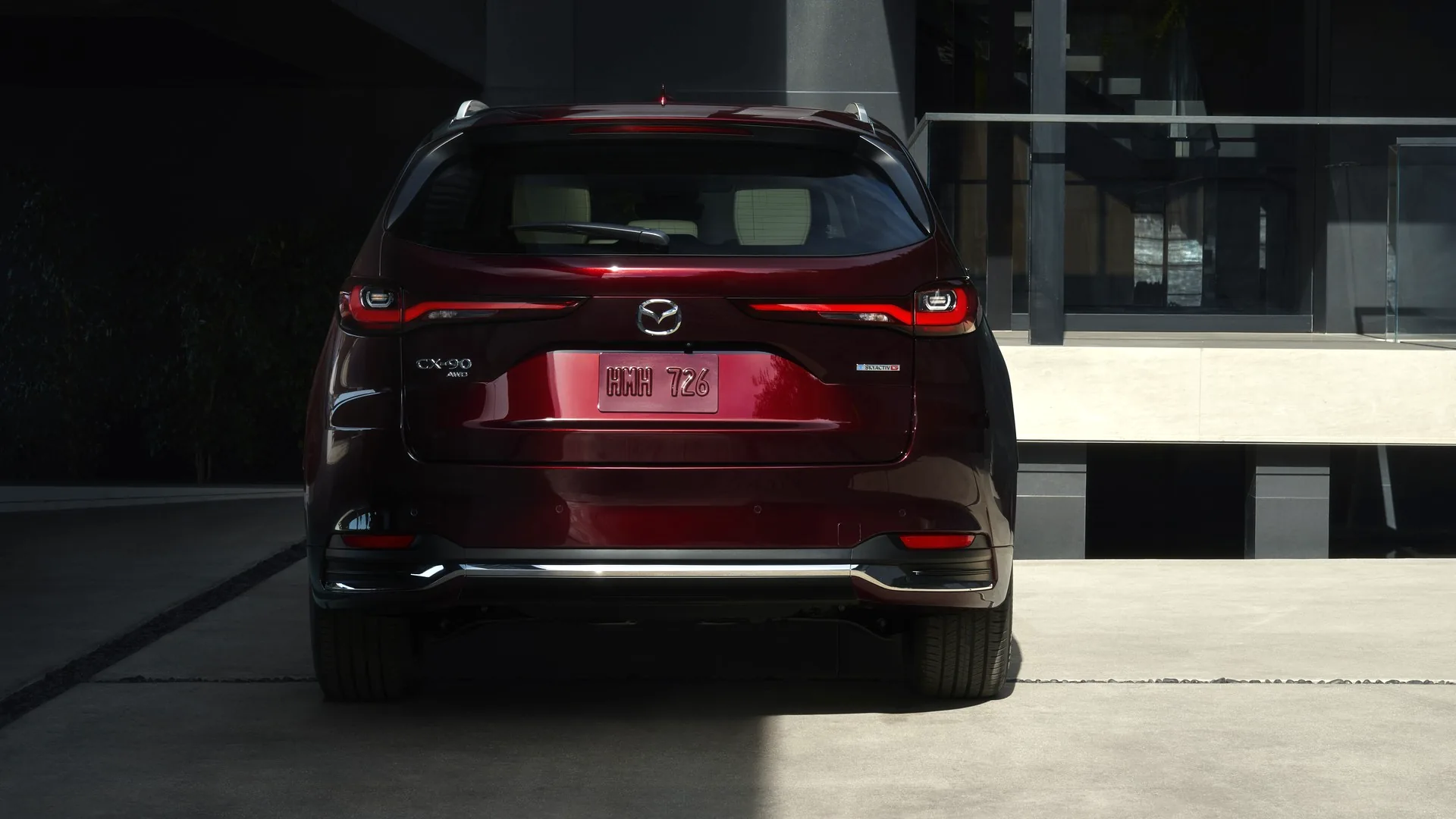
Exactly the same length as the CX-70 — 5,100 mm, on the same 3,120 mm wheelbase — but three rows. The CX-90 is the only Mazda SUV in the network that carries seven or eight people.
The base configuration is a 2-3-3 for eight seats. From the GS-L trim, captain’s chairs in the second row are available as an option, which gives a 2-2-3 for seven seats. The Signature trim gets these chairs as standard: it is therefore a seven-seater.
| Configuration | Behind the third row | Behind the second row | Behind the first row |
|---|---|---|---|
| 8 or 7 seats | 423 L | 1,133 L | 2,101 L |
| 6 seats | 451 L | 1,155 L | 2,129 L |
The figure to remember is 423 litres. With all eight seats occupied, the CX-90’s cargo area is smaller than the CX-30’s. This is true of all three-row SUVs, and it is exactly why the CX-70 exists: if the third row is only used three times a year, the CX-70 gives you 1,131 litres all year long.
On the mechanical side, the mild hybrid CX-90 uses the 280 or 340 horsepower inline-six (10.1 / 8.5 / 9.4 and 10.3 / 8.5 / 9.5). The GS trim tows 1,588 kg (3,500 lb); from the GS-L, capacity rises to 2,268 kg (5,000 lb) with the original towing accessories. The plug-in CX-90 offers 43 km of electric range and tows 1,588 kg.
See the sheets and current prices: CX-90 mild hybridFR · CX-90 plug-inFR.
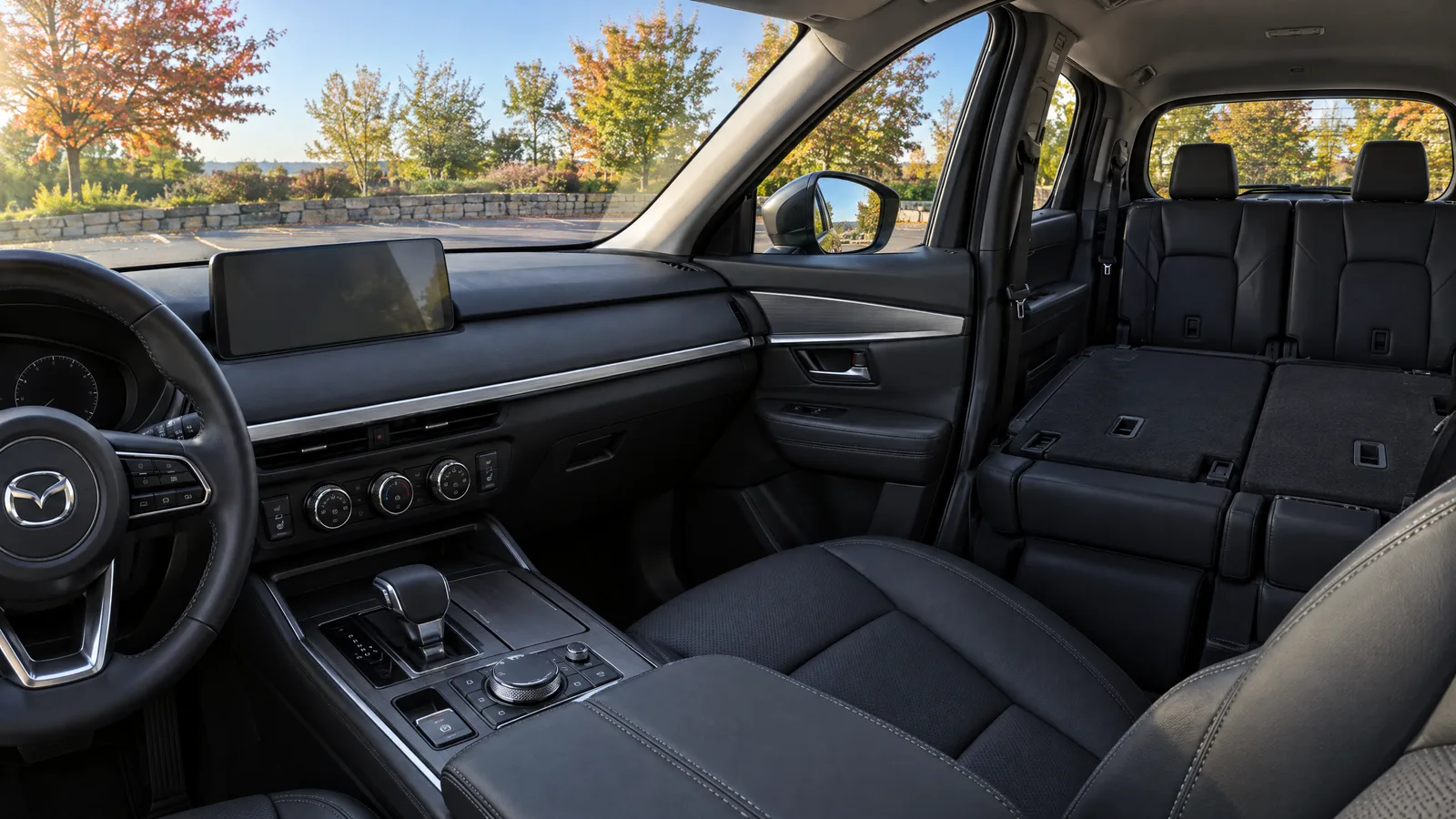
All-wheel drive, standard on every model
This is the Mazda feature that matters most in Quebec: all four models are offered only with i-Activ AWD all-wheel drive. The six Canadian trims of the CX-30, the five of the 2026 CX-5 and all those of the CX-70 and the CX-90 are in Mazda Canada’s catalogue with all-wheel drive.
Practical consequence: the stated consumption is already that of the all-wheel drive. The brochure figure is not obtained with a two-wheel-drive version that nobody in the region buys. To compare all-wheel drive across the network’s brands, see the full list of new Groupe Beaucage vehicles.
Where to see the current price
New vehicle prices change from one model year to the next, and sometimes during the year. Rather than an amount that would go out of date, each model above carries a link to its page on the dealership website, where the displayed price is the one of the day, trim by trim.
Three useful pages for what comes next: the network’s offers page for current discounts, your trade-in appraisal, and the list of new plug-in hybrids in the network if the plug-in CX-70 or CX-90 interests you.
Compare the new Mazdas in the network Appraise my current vehicle Find my Mazda dealership
 Watch the video on YouTube
Frequently asked questions
Does the mild hybrid CX-70 plug in?
No. The 48-volt M Hybrid Boost system recharges by itself, through braking and the gas engine. It has no plug, and its 0.33 kWh battery never allows driving on electricity alone. Only the plug-in CX-70 and CX-90, with their 17.8 kWh battery, plug in.
Which Mazda SUV has the biggest cargo area?
The CX-70, with 1,131 litres behind the second row and 2,147 litres with the seats folded. The CX-90 beats it only when its third row is folded. With all seats occupied, the CX-90 offers 423 litres.
How many seats in the CX-90?
Eight in the 2-3-3 configuration, which is the standard one. Captain’s chairs in the second row, optional from the GS-L trim and standard on the Signature, bring the total to seven.
Are these consumption figures still current?
They come from Natural Resources Canada’s official ratings for the 2026 model year, gathered on . These ratings are revised with each model year: if you read this text later, check the model page, which carries the current information.
Do you have to put premium gas in a Mazda?
It depends on the trim. The CX-30, the CX-5 and the 280 horsepower mild hybrid CX-70 and CX-90 run on regular gas. The 340 horsepower high-output versions and the two plug-in models have premium gas as the recommended fuel; the 340 horsepower versions also work on regular, with 319 horsepower instead of 340.
Where can I see the price of a specific trim?
On the model page, in the configuration section: each trim carries its current price there. The links in this article lead directly to those pages.